Know what to build next.
Most founders don’t need more features. They need to know which ones matter, what they’ll cost, and what can wait. Rishik Gupta. DevAxis is a one-person practice in Cambridge, Ontario, so the person writing this is the person who does the work. Nothing gets handed to a team you have not met. help non-technical founders decide, then I build it.
I’m Rishik Gupta, Technical Lead for TheHomeTaste: customer, cook, and driver apps plus an admin platform, two of them live on the App Store and Google Play.
Where are you right now?
Pick the sentence that sounds most like your situation. You’ll get a straight answer, on this page, with nothing to fill in.
The problem usually isn’t the code
Most stalled products aren’t stalled because nobody can build them. They’re stalled because nobody decided what to build first.
The feature list keeps changing. Customers ask, mentors advise, investors suggest, operations need something, a competitor ships something new. Every input is reasonable. Together they turn development into something reactive.
That’s the gap I work in: product The list of what a project includes, agreed in writing before work starts. Anything outside it is a change request with its own cost and timeline, rather than something quietly absorbed. and technical prioritisation, before development starts.
“The features kept changing.”
Freelancer, agency, technical partner
All three are the right answer for someone. Here’s how I’d tell them apart if you were asking me on a call.
| A task-based freelancer | An agency | Me | |
|---|---|---|---|
| What you get | Builds what you specify | Sells a predefined package | Works out what’s worth building, tells you what to skip, then builds it |
| Good when | You already know exactly what you need | You need scale and have the budget for it | You have a clear business vision and an unclear technical plan |
| The risk | If the spec is wrong, you get a well-built wrong thing | You pay for scope you don’t need yet | One person’s capacity. I take on fewer projects on purpose |
You don’t need all four
You can start anywhere. Most founders who aren’t sure what to build start with a Discovery Sprint, because a $1,200 plan is cheaper than a $6,000 wrong build. If you already have a clear scope, skip it. I’ll tell you if I think you need it.
The four packages connect in sequence but you can start at any of them. A Technical Discovery Sprint produces a plan. Web Development or Mobile Application Development builds from that plan. A Backend, API and Security Module Sprint improves something that already exists. Most founders use one or two, not all four.
Start here if the plan is unclear.
Start here if the plan is already clear.
Start here if one specific thing is broken.
A real decision: TheHomeTaste
I was asked for two apps in three months. What the business actually needed was five connected pieces: customer app, cook app, driver app, admin platform, backend. Saying so was the useful part of the job.
What I didn’t build mattered as much: no support chat agent, no catering page, and the driver app deliberately deferred until a month before launch, so the ordering and cooking flows could be right first.
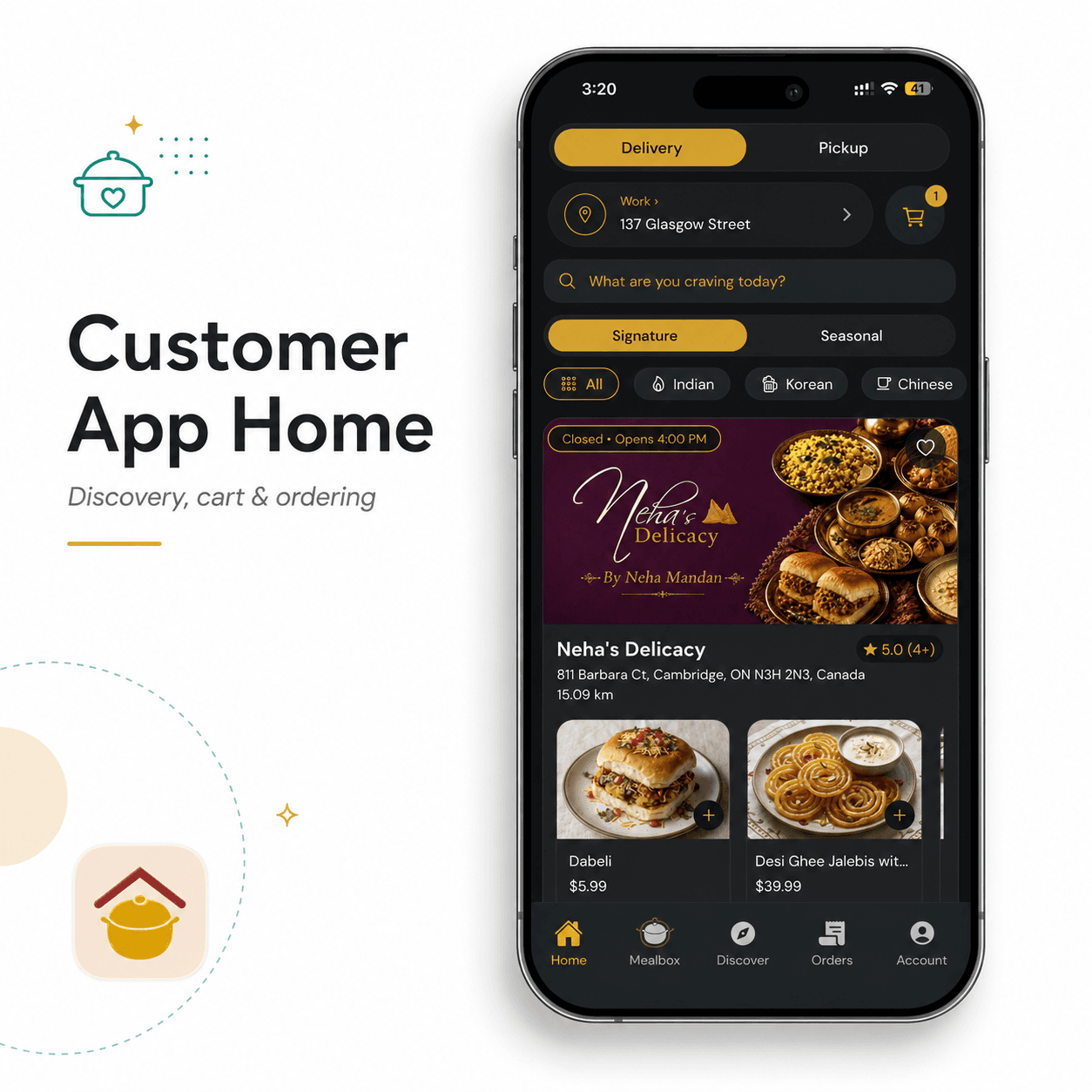
Customer App UX 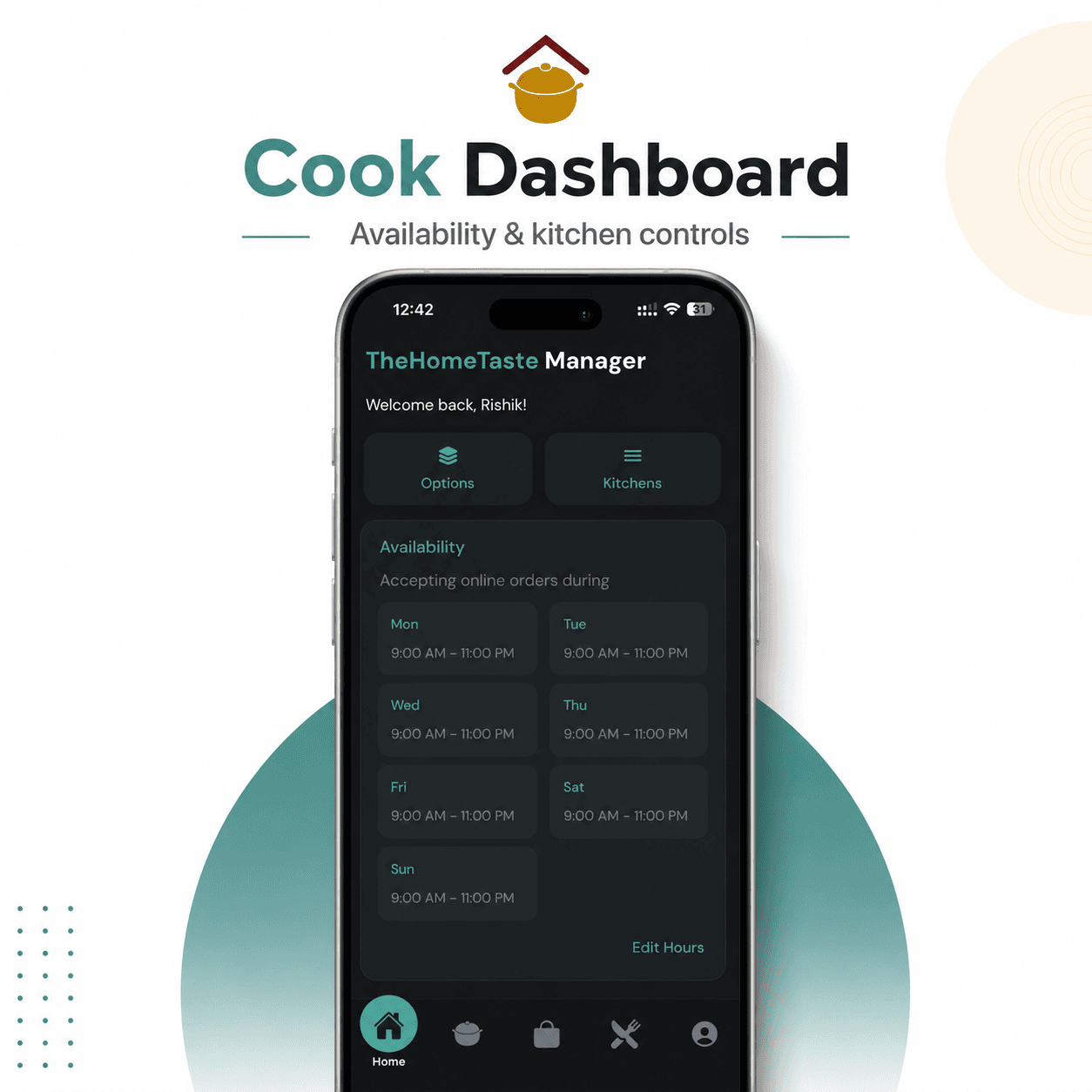
Cook Manager App
How I work
Seven steps. The second one is the reason people hire me.
Step 1
Understand
What you’re trying to achieve, who it’s for, and what’s actually in the way.
Step 2
Challenge
If a feature, timeline, or assumption doesn’t make product sense, I say so. This is the part people remember.
Step 3
Recommend
What to build first, what to skip, and what it’ll cost. In plain language.
Step 4
Plan
A written scope: what’s included, what isn’t, milestones, and dates.
Step 5
Build
Development in scoped phases with working check-ins, not one black-box handoff.
Step 6
Launch
Testing, deployment, documentation, and app-store guidance where it applies.
Step 7
Improve
What the product tells you after real people use it.
Communication, revisions, scope changes, and handover, all stated up front
Who says so
These are references from the team I worked with at TheHomeTaste: the founder and three colleagues. They’re not DevAxis client testimonials; DevAxis is new and I’d rather say so than blur it.
Rishik demonstrated exceptional leadership and ownership at The HomeTaste. He consistently took initiative, translated business needs into reliable technical solutions, and remained accountable through complex challenges. His ability to think beyond assigned tasks and lead with a product-focused mindset made him a dependable and valuable member of our team.
Shaileshkumar RathodFounder & CEO, TheHomeTaste Rishik took strong ownership of TheHomeTaste cook platform and ensured it integrated cleanly with the customer, driver, and admin systems. His full-system thinking, communication, and execution made the entire product stronger.
Sufiyan ShahSenior Software Engineer, TheHomeTaste Rishik is technically strong, dependable, and always willing to help. His work on TheHomeTaste showed creativity, attention to detail, and a strong focus on delivering a polished, user-friendly product.
Rohan KumarSenior Software Engineer, TheHomeTaste Rishik consistently brought strong technical knowledge, professionalism, and a solution-focused mindset. Whether supporting product issues or cross-functional teams, he was dependable, collaborative, and efficient throughout his work with TheHomeTaste.
Pallavi ZoreSocial Media Manager, TheHomeTaste
What it was built with
Two apps live on the App Store and Google Play.
- React Native
- iOS and Android
- Backend and API
- Admin platform
Tell me where your product stands.
Tell me what you’re building and what’s in the way. I’ll reply with what I’d do first - whether or not that involves hiring me.
Not ready? find your next move first